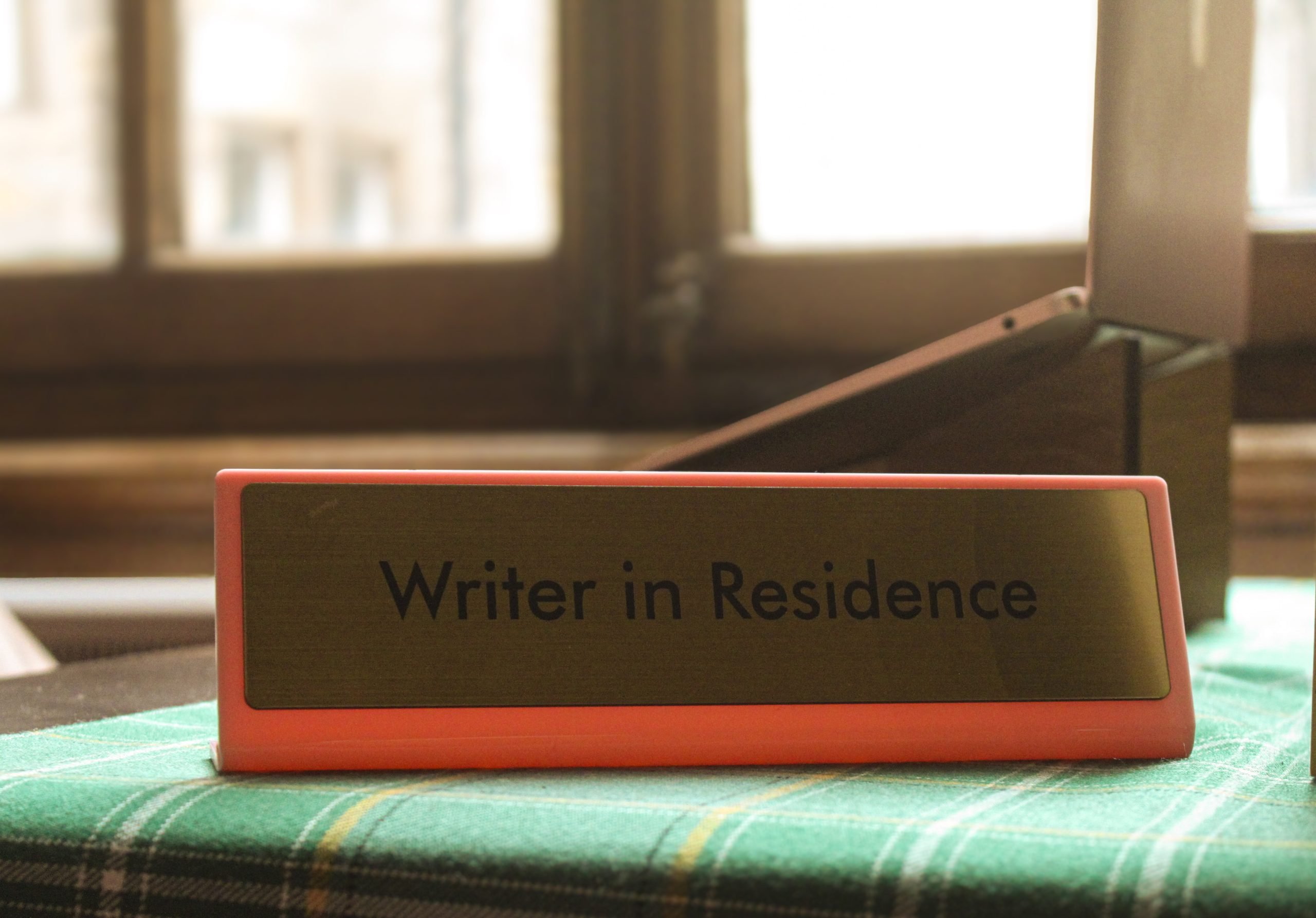

Writer’s Room Writer-in-Residence Lucy Ribchester reflects on her time at the Writers’ Museum. Lucy spent June and July working on her novel-in-progress in the inspiring space.
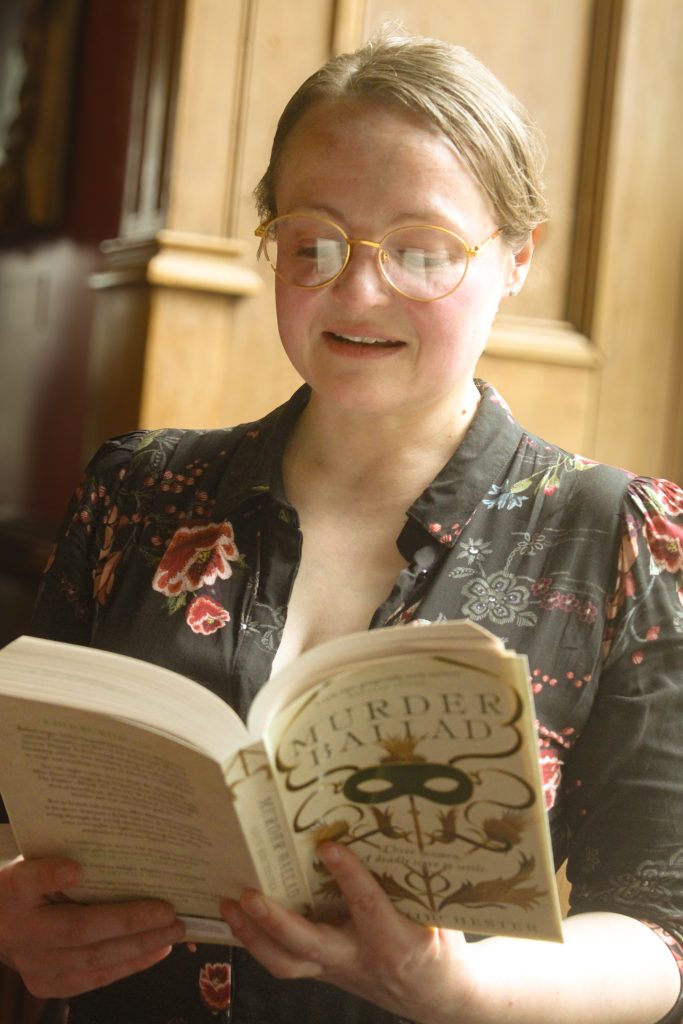
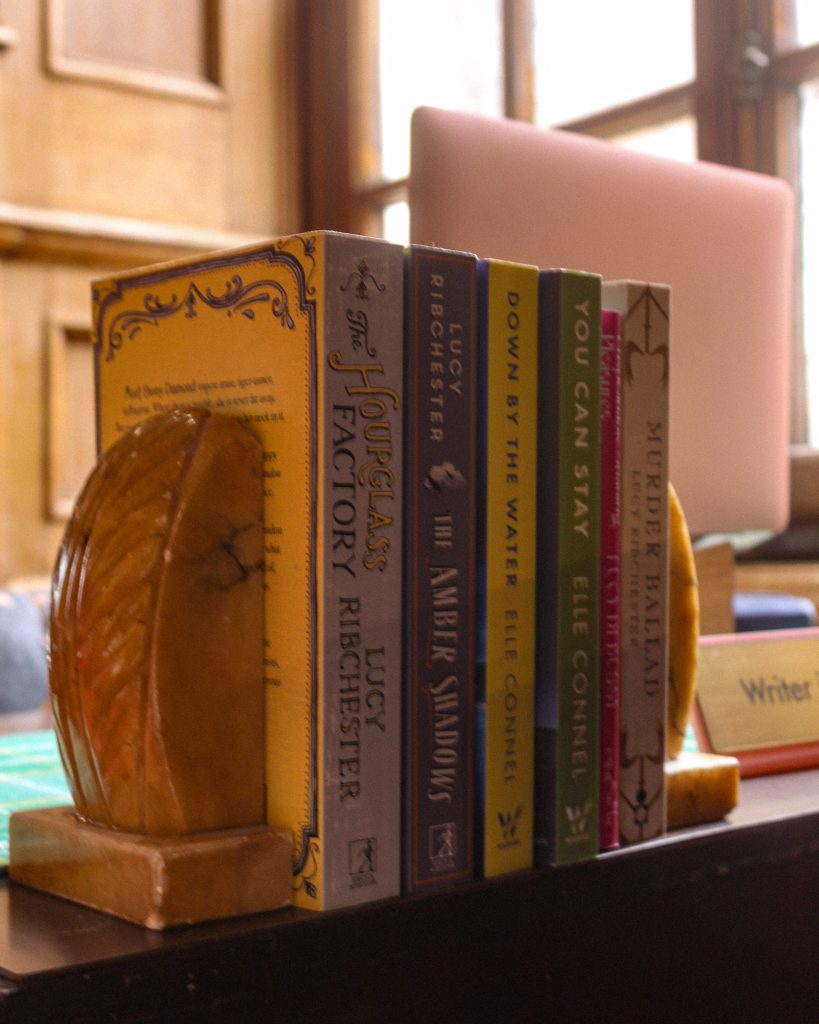
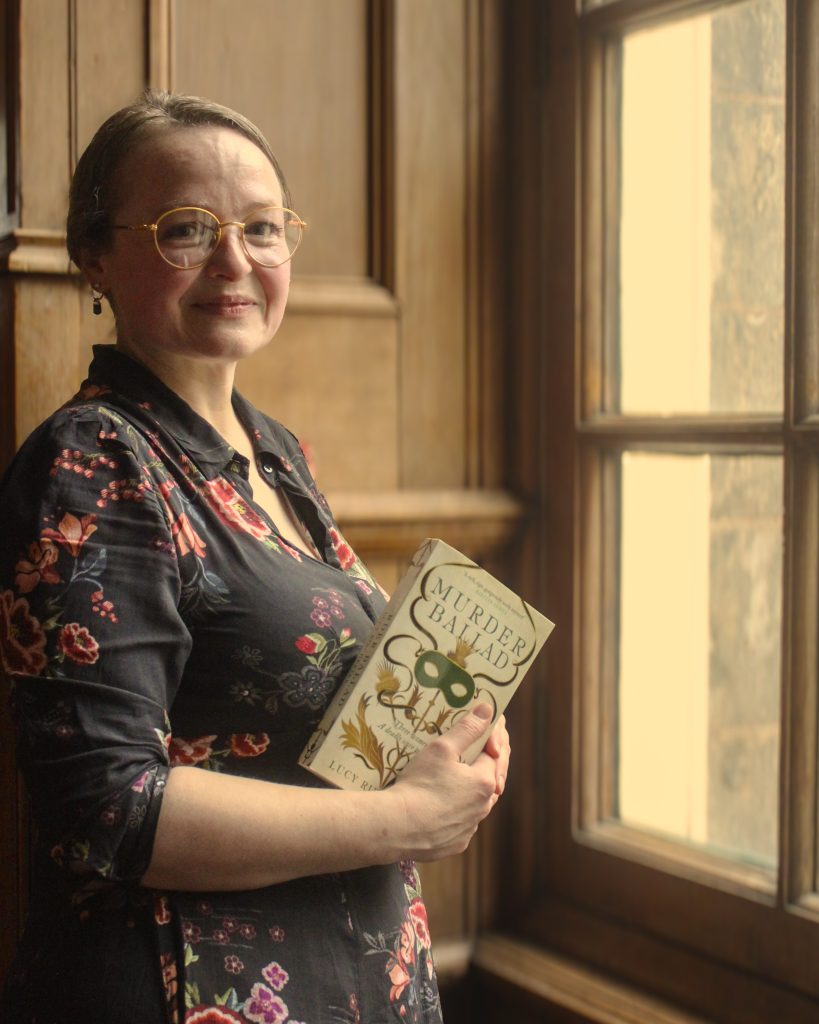
Lucy Ribchester is an Edinburgh-based novelist and short story writer. Her debut novel, The Hourglass Factory, was nominated for the Historical Writers Association Debut Crown, while her latest novel, Murder Ballad, is set in 18th-century Edinburgh’s Old Town. She is currently a Royal Literary Fund Fellow at the University of Edinburgh.
There is a lamppost in the middle of a square, just off the Royal Mile in Edinburgh. I couldn’t actually have told you the name of the square before looking it up (Wardrop’s Court – I would have said Lady Stair’s Close and been wrong). It looks Victorian, probably originally gas. I’ve never seen it lit and it doesn’t appear to have a bulb. This doesn’t stop it from being an extraordinarily popular draw for photographs. Every day, families, couples, groups of friends, professional photographers flock to this lamppost. Newlyweds kiss in front of it, children jump from its pedestal and are caught mid-leap by the camera. People in tweed exact angular, jaunty balances away from it to best show off their waistcoats, fluted skirts and hats (costumes or clothing they are modelling?)
This morning, a family played ring-a-ring-a-roses round the lamppost while a photographer with a zoom lens directed them to lean and bend, stop and go. The other day a photo crew enticed the square’s resident flock of pigeons towards the lamppost with grain, then stamped to send them fireworking into the air in a choreographed, muscular white-bellied arc. Young women, when confronted with this lamppost, always adopt the same pose: one hand on the post, one leg cocked at the knee. One afternoon a man (in tweed) set up a tripod and took shot after shot after shot of him kissing a woman (also in tweed), adopting this pose, pausing between each shot to show her the image on his phone, reset, repeat, reset, repeat. I could not figure out what their quest was: to sell the tweed they were wearing, to sell an image of Edinburgh, or simply to capture a moment of confected romance, the confection so honed, rehearsed, polished and practiced that it passed through the looking glass of confection and appeared once again spontaneous, natural.
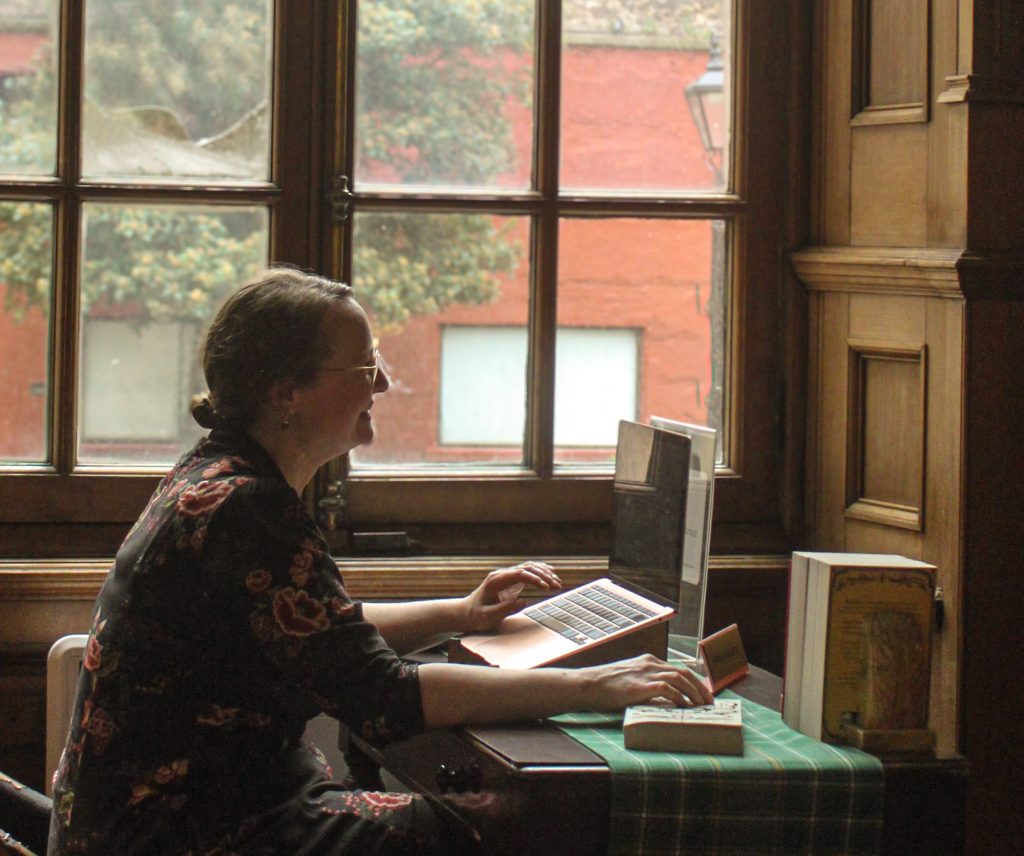
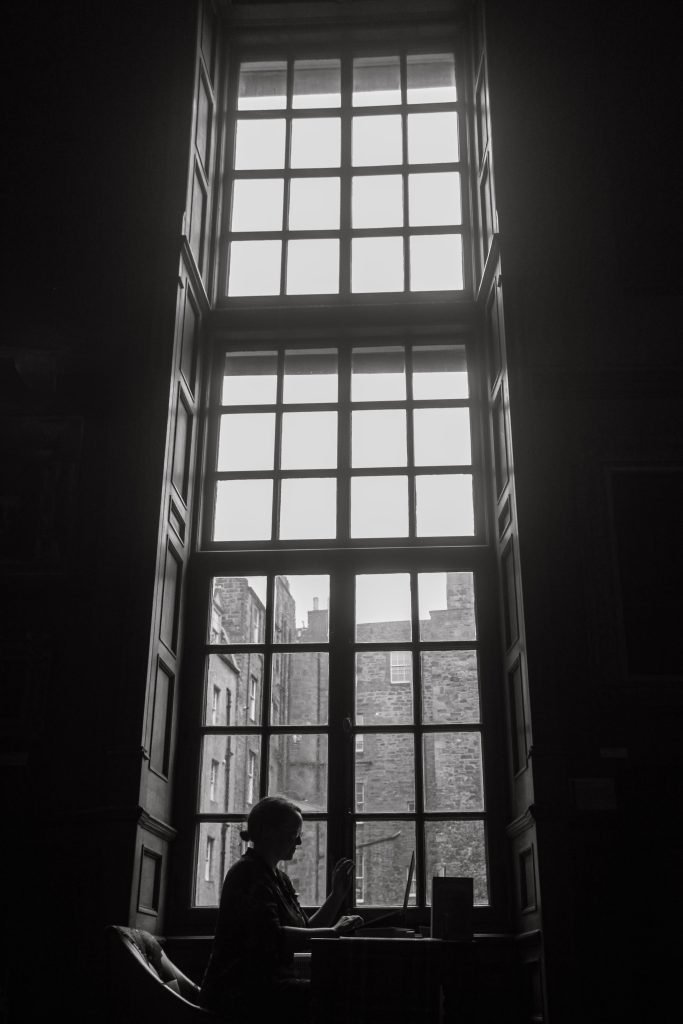
How and why did I spend so long contemplating this extraordinarily beloved lamppost? Behind it stands the Writers’ Museum, the small Edinburgh shrine to Walter Scott, Burns and Stevenson (their busts are looking at me now as I write – Burns, actually, is looking the other way, perhaps he wanted to show off his ‘best side’ to the sculptor), and I have been writer-in-residence here for the past two months. I sit beside an enormous window, impossibly tall, Lewis Caroll tall, and square-paned like something Alice might confront in wonderland. My view is through one of those small panes, and possibly, possibly if the light is shining at the right (or wrong) angle, my tiny ghostly face might appear in the background of one or more of these lamppost photographs, like the creepy, ghostly faces we read about sometimes in insalubrious corners of the internet, popping up in old school photographs and family holiday snaps. Perhaps all along, those little ghosts too were just writers, spying and documenting from the other side, as writers do.
(There is a busker outside now, a guitarist playing a melody I can only just hear, beside the lamppost; is he serenading the lamppost? Has this lamppost now become so famous it has its own troubadour?)
‘What does a writer-in-residence do?’ I am sometimes asked by passing visitors to the museum.
It is a good question. I tend to reply quite pragmatically, that in my case I’m using the residency to finish my novel, which I had drafted but not edited when I applied for it. That residencies give writers time, money, permission (that most crucial factor) to write. I – like many writers – am a parent, a freelancer, a person with a mortgage, and it is often hard to convince myself that writing time (often unpaid, or speculatively gambled in the hope of selling the finished manuscript) is as worthwhile as hustling for teaching work, or pitching pieces of journalism, or applying for more residencies and grants.
But there is also the matter of space in a residency. What kind of space facilitates what kind of work? Another question I have been asked a lot by visitors: ‘How do you get any work done at all?’ Sometimes I don’t. My agent, when I told her I would be working inside a museum for two months – a living exhibit – said, ‘THIS IS AMAZING…you will be unable to doss around and will have to be writing very seriously at all times.’ Both have been true. I have found myself with my head down and my mind in medieval Perth for the best part of an hour, then have surfaced to chat to visitors; a songwriter from Colorado, a retired engineer from Canada, budding fantasy novelists from Denmark and Germany. I have had wonderful chats with wonderful curious, generous people. And I have stared out of the window at the lamppost, straight into the lives of others.
I have often wondered how many people the world over now have the same lamppost wedding photo, the same angle of kiss, the same tilted head (the knee is never cocked in the wedding photos). And I wonder too in the weeks and months to come, when my memories have percolated, how many of the lamppost people will melt their way into my fiction.
(A family just now are sitting at the base of the lamppost, picnicking on sandwiches; one of the children is offering part of his baguette to a seagull. I am sorely temped to open the window, break the fourth wall, and call out to him the folly of this monstrous plan).
Who of the people I’ve crossed paths with or watched might take up a market trade in 14th century Perth? Who could become a forester, an armourer, a friar (the effusive tour guide who reminds me of my friend?) or an illegal cake baxter (the tour guide who punctuates her speeches with a witch-cackle?). Whose uncertain kiss might be poached to form a pivotal moment in the novel, or in novels to come, or whose louche swagger might I borrow to copy from life the body’s expression of that mood? (The pigeons, for certain, have already made it in).
Sometimes I say the same thing to visitors; that most writing residencies cloister you away in solitude, and that this one is unusual because it places you in a public space, to be looked at as you work. It is odd, the feeling of being looked at while you concentrate; a soft, almost brushing sensation on the skin. But I have done my own fair share of looking too.
The lamppost on its own reminds me a little of the tree in the Hans Christian Andersen story, that longs to be cut down and decorated at Christmas time. It looks slightly forlorn, austere, rigid, a little battered and scratched. I’m sure it has weathered its fair share of dogs’ pee and pigeon droppings. But when people are around it, interacting with it, it comes to life, it forms a solid central brace for any number of tiny, swift micro-stories. How it has travelled too, to walls and phones and Instagram accounts around the world, in a cascade of photographs, captured, innocuous, invisible (almost). And yet its purpose in these photographs will always be the same; to serve as the frame, the structure that facilitates the story, not the people who live and breathe in it.
Learn more about Lucy at lucyribchester.com
Our second Writer-in-Residence, Shelley Day, has just finished her residency. Stay tuned for updates about her time at the Writers’ Museum.
Writer’s Room at the Writers’ Museum is possible thanks to the support of the City of Edinburgh Council and the Amazon Literary Partnership.